Shopping Cart


Out of stock

€7.23 tax excluded
Description
Description
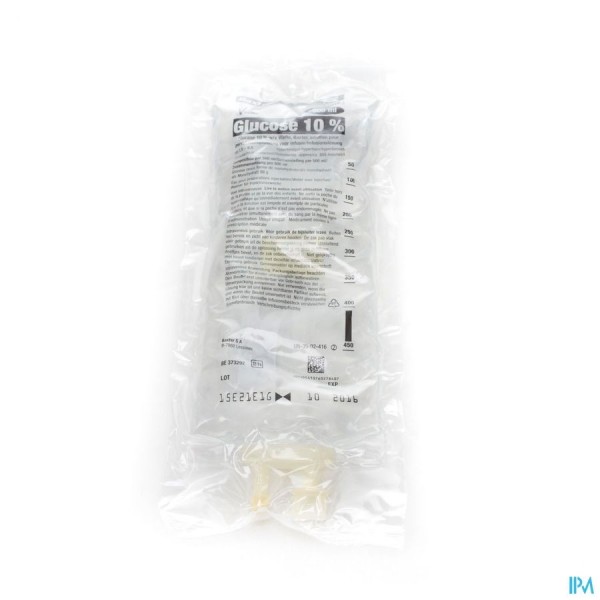
Glucose 10% will be administered to you by a doctor or nurse. Your doctor will decide how much you need and when it will be given. This depends on your age, weight, condition, and the reason for use. The dosage may also depend on any accompanying therapy.
Glucose 10% must NOT be administered if the solution contains particles or the bag is damaged.
Glucose 10% is usually administered into a vein via a plastic tube and an attached needle (cannula). An arm vein is most commonly used for the infusion. However, your doctor may decide to administer the medication in a different way.
Before and during the infusion, your doctor will monitor the following: - the amount of fluid in your body - the acidity level in your blood and urine - the amount of electrolytes in your body (especially sodium, in patients who have high levels of the hormone vasopressin, or are taking other drugs that increase the effect of vasopressin).
Any remaining solution must be discarded. Glucose 10% must not be infused from an already opened bag.
What glucose 10% contains
The active ingredient is glucose (as monohydrate): 100 g/liter. The only other ingredient is water for injection.
Composition per 250 ml: Glucose (as monohydrate): 25 g
Composition per 500 ml glucose (as monohydrate): 50 g
Composition per 1000 ml glucose (as monohydrate): 100 g
Glucose 10% must NOT be used if you suffer from any of the following conditions: • Uncontrolled diabetes, i.e., if your blood sugar levels reach abnormally high levels (decompensated diabetes mellitus). • Unconsciousness (hyperosmolar coma). This type of coma can occur in uncontrolled diabetes. • Blood thinning due to excessive fluid intake (hemodilution). • If there is too much fluid in the space outside your body's cells (extracellular hyperhydration). • If the blood volume in your blood vessels is above normal (hypervolemia). • Elevated blood sugar levels (hyperglycemia). • Elevated blood lactate levels (lactate is a chemical substance) (hyperlactatemia). • Severe kidney failure (if your kidneys are not functioning properly and you require dialysis). • Decompensated heart failure. This is a weakened heart that has not been adequately treated and causes, among other things, the following symptoms: • Shortness of breath; • Swollen ankles; • Fluid retention under the skin, which can affect all parts of the body, including your brain and lungs (generalized edema).
• Liver disease in which fluid accumulates in the abdominal cavity (ascites liver cirrhosis).
• Any cause that affects your body's blood sugar control. • Glucose intolerance (hypersensitivity). This may occur in patients who are allergic to corn.
This is a medecine available without a prescription.. Do not use long without medical advice. Read the instructions carefully. Keep this medicine out of the reach of children. Keep the manual as it contains important information. Ask for advice from your doctor or pharmacist. Consult your doctor if adverse reactions.
'